There's a moment on every first desert drive when a dune stops being scenery and becomes a challenge. The face rises ahead, your passenger goes quiet, and your right foot presses harder than you intended. First big ascents tend to end one of two ways: a clean glide over the crest, or a spinning, dug-in mess halfway up with a queue of vehicles waiting behind you. The difference is rarely the vehicle. It's a handful of habits that experienced drivers have already drilled out of themselves.
Choosing the Wrong Gear, Then Changing It Too Late
Sand rewards a long, steady pull rather than a surge of revs followed by an upshift that dumps your speed. The classic beginner error is charging at the dune in a gear that's too high, losing momentum three-quarters of the way up, then stamping down a gear. By that point the tyres are already spinning and the downshift just digs you in deeper.
Pick your gear before you commit. In a manual, that usually means low range in second or third, depending on the vehicle and how steep the face is. In an automatic, select the gear yourself rather than letting the box hunt for one halfway up. If you need full throttle simply to hold your speed on the face, you were in the wrong gear two hundred metres back.
Tyre Pressure Treated as an Afterthought
Road pressures are for roads. On sand you want a longer, flatter contact patch so the vehicle floats across the surface instead of cutting into it. Dropping pressures is the single biggest change most new drivers can make, and it's the one they skip because letting air out of your tyres feels instinctively wrong.
Ask your local club or the vehicle handbook for a sensible starting figure for your weight and tyre type, then experiment on a flat area before you tackle anything steep. Do it before you reach the sand, not after a failed run. Carry a good gauge and a compressor that works quickly, because a slow one is a compressor you'll avoid using. Remember that low pressures mean lower speeds and gentler steering on any hard surface, so reinflate before you rejoin tarmac.
Losing Momentum Before the Crest
Momentum isn't just speed — it's sustained drive. The most common way to lose it is lifting off the throttle the moment the bonnet rises and the sky fills your windscreen. That's precisely when you should stay committed on the power, keeping the tyres driving rather than letting the sand drag you to a halt.
The second way is a hesitant approach: trickling onto the face while you decide whether you really want to do this. A slow entry means you're already behind the curve. Line up early, give yourself a straight run, and commit. And if you have to stop on a slope, stop pointing downhill. Restarting uphill from a standstill is a lesson nobody enjoys.
If you can't see over the crest, you can't commit to it. Send someone ahead on foot, or pick a line you can read.
Turning Uphill
Of all the mistakes on this list, turning uphill is the one most likely to put a vehicle on its roof. When you turn across the face of a dune, the sand builds up on the outside of the tyres and the vehicle starts to slide sideways. On a steep face, that slide is the beginning of a roll, not a bit of fun.
If you need to change direction, turn downhill. If you're already sliding, steer gently into the slide, ease off the throttle smoothly, and avoid stabbing the brakes — a locked wheel digs in and trips the vehicle. Complete the descent and try again with a better line. Nobody is scoring you on how many attempts it takes.
Following Tracks You Didn't Make
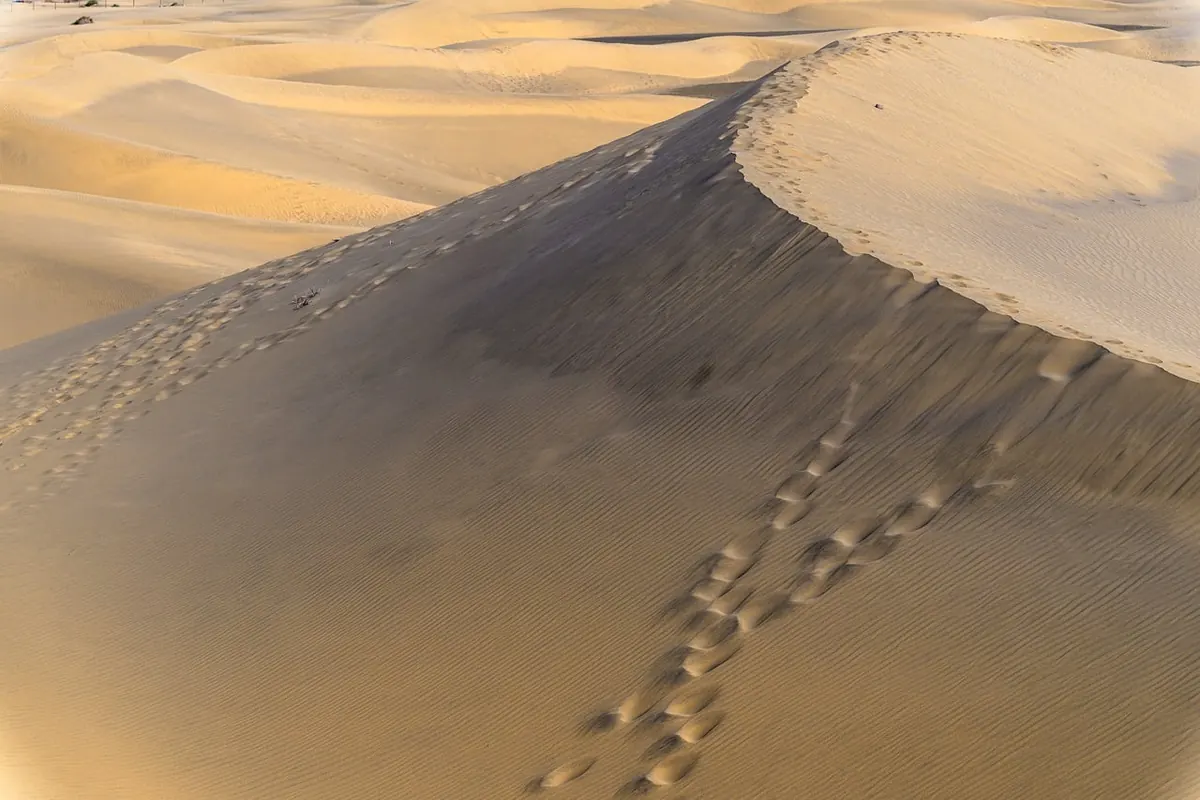
Tracks are useful information, not rails. Those ruts were cut by a different vehicle, with different weight, power and tyre pressures, driven by someone who may have known exactly what they were doing or nothing at all. Use them as a clue about firmness and direction, then choose your own line.
Learn to read the sand while you're at it. Darker, cooler-looking sand in the shade of a crest tends to hold together better than pale, powdery stuff. Wind-scoured faces are usually firmer than sheltered lee slopes. If a face looks soft and loose across the whole width, find another way over.
The Boring Checks That Save the Day
None of this is glamorous, and all of it matters more than tyre choice or engine size:
- A proper gauge and a compressor, tested before you leave home.
- A shovel, sand ladders, rated recovery points and a suitable tow strap.
- A tall flag or whip so other drivers can see you over a crest.
- Water for everyone, plus sun protection, regardless of the forecast.
- Radio or comms, and someone outside the group who knows your route and return time.
- At least one other vehicle. Solo desert driving removes your margin for error.
Never cross a blind crest at speed. There may be another vehicle, a steep drop, or a camel on the far side. Slow down, check the radio, and if in doubt, walk it first.
When It Goes Wrong: The Reset That Works
If you're dug in halfway up, stop spinning. Wheelspin only buries you deeper and heats everything up for no gain. Then work through the reset:
- Assess the slope and your angle. If you can reverse straight back down under control, do that in the same gear.
- If you can't reverse, dig the sand away from all four tyres and lay ladders or mats in front of the driven wheels.
- Drop a couple more psi and pick a lower gear than last time.
- Back off far enough to build a straight, committed run, and choose an easier line if the one you tried keeps beating you.
- If it still isn't working, drive around it. There's no prize for conquering one particular dune.
Then spend your next session on small bowls and short climbs, where a mistake costs you nothing but a bit of digging. Build the feel for how the vehicle floats, when it starts to labour, and how much throttle it takes to keep the tyres driving rather than spinning. That feel is what carries you over the big faces later — not bravery, and not a bigger engine.
Photo: BernhardJaeck / Pixabay